Takhi Post

Learn more about the Eurasian cold steppe and its threats. How can it survive and how can different actors work together to support this unique ecosystem and the nomads living in the region. You will also find a portrait of Mongolia’s last wild camels. In the news in brief you can find out more about the Takhi workshop in Hustai (MN), the UNESCO World Heritage application for the Gobi and why some gazelles wear a collar around their neck. Read the latest Takhi Post here.

International network of Takhi conservation projects

The Mongolian wild horse, called Takhi in the Mongolian language, was wiped out in the wild at the end of the 1960s. Only twelve individuals of these emblematic steppe wild animals survived in zoos. The species was preserved through captive breeding and later in large enclosures under semi-natural conditions. In 1992, the first reintroduction projects for takhi in the wild were launched in Hustai National Park and the Dzungarian Gobi Specially Protected Area in Mongolia. The project in the Gobi has been supported by ITG with expertise and funding for 25 years now. In order to build up a network of the conservation projects under semi-natural and natural conditions, project managers from Mongolia, China, Kazakhstan, Russia, Hungary, the Czech Republic, France, Spain and Switzerland met for a workshop in Hustai National Park in Mongolia between the 23rd and 26th of September 2024. At the end of the meeting, the President of ITG promised to actively support the international coordination of the various projects.

The photo shows the Great Gobi B & Numrug team.

Visit of the ITG president in Takhiin Tal

In September, ITG President Reinhard Schnidrig visited the Takhin tal Camp on the edge of the Great Gobi ‘B’ specially protected area to discuss the current ITG projects on sustainable cashmere use and ecotourism with the director, the rangers, and the ITG team on site and to take part in one of the regular wild horse monitoring tours.
His conclusion after the tour through the vast steppe: ‘To observe around 250 wild takhi in one day, including a large herd of over 100 wild horses, coloured in autumnal gold, makes the heart bounce!’

Meeting with the Environment Minister

On the 3rd of October 2024 the President of the International Takhi Group, Dr. Reinhard Schnidrig, met the Minister of Environment and Climate Change of Mongolia, Odontuya Saldan, to report about the successful reintroduction of the Przewalski’s Horse, also called Takhi, in the Dzungarian Gobi of Mongolia. They also discussed the application for nominating a network of six protected areas in the Mongolian Gobi as a Unesco World Heritage Site.

UNESCO World Heritage Site

Unesco World Heritage Sites are the most exceptional natural places in the world, characterized by their outstanding biodiversity, ecosystems, geology, and superb natural phenomena. The International Takhi Group ITG, in partnership with the Michael Succow Stiftung (Foundation), the Mongolian Bird Conservation Center – Монголын шувуу хамгаалах төв, and the Inland Norway University of Applied Sciences launched the project to prepare for the nomination of the Mongolian Gobi in 2023, embracing a network of six protected sites with a combined surface area of 83’000 km². To advocate for support for this project with high international visibility, ITG President Reinhard Schnidrig and ITG Executive Director in Mongolia Batsukh Jamiyandorj met the UN Resident Coordinator in Mongolia, Tapan Mishra, on the 3rd of October 2024 in Ulaanbaatar.

Study on goitered gazelles

In Great Gobi B SPA twelve Goitered gazelles – 6 males and females in 3 different areas – were captured and are now wearing GPS solar collars. The data will provide Great Gobi B SPA with much needed information on this beautiful gazelle species in the plains of the protected area.

The project is supported by the following organisations:

Lena Michler

Managing Director of ITG Europe

Lena Michler is since June 2024 the Managing Director of ITG Europe.
She continues her work focused on the socio-economic topics but is also taking over the management of the operational tasks of ITG. She is coordinating between the ITG Bureau and the ITG Mongolia team.

First Takhi-foal of 2024

Happy to announce: the first Takhi-foal of 2024 in the Great Gobi B SPA is born on April 19th! As a result of the successful reintroduction and the Takhi growing wild again, the newborn can only be seen from far away or through the telescope until now.

The Takhi are well, also due to the pasture of the Gobi B, which is very good and nourishing this year. Rangers have observed about 60-70 pregnant mares: there are many more Takhi-foals to come this year!

Foto: Altansukh Nanjid

takhi e

Read the latest Takhi Post

The topics and challenges of the ITG cover a wide field, from the application for a UNESCO World Heritage Site, to the health monitoring of wild and domestic animals and training for rangers to various research projects. Read what’s going on in the Gobi B in the latest Takhi Post.

ITG-Workshop 2024

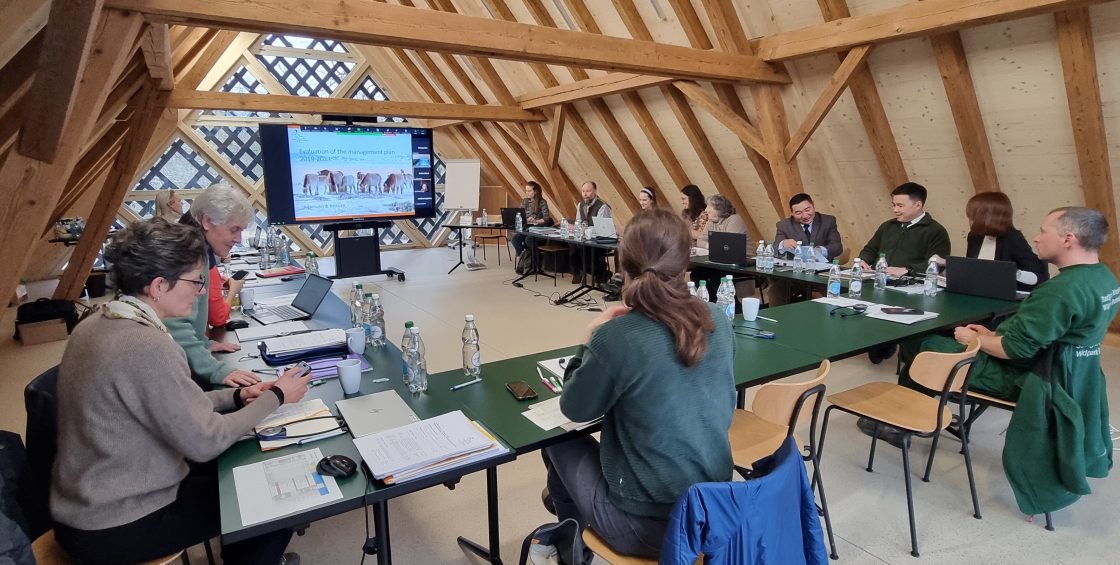
This year’s ITG-Workshop was under the motto “New Strategies”. We hosted the workshop in the building “Fauna” in the wildlife park Bruderhaus in Winterthur, Switzerland. The Mongolian delegation arrived with two participants from the Mongolian Ministry of Environment and Tourism (MET), the director of the Great Gobi B and the ITG executive director of Mongolia. The ITG board members also welcomed participants from the Frankfurt Zoological Society, partner zoos (Nurenberg and Berlin), and the Hanns-Seidel Foundation. During three days new strategies for the Great Gobi B were discussed concerning the protected area management, environmental and social challenges, the one-health approach, and the takhi management in the future. New ideas were created, ongoing activities evaluated and deepened further and the takhi in Winterthur were observed with a smile on our faces. Currently, around 260 of this unique species are roaming in the Gobi steppe.